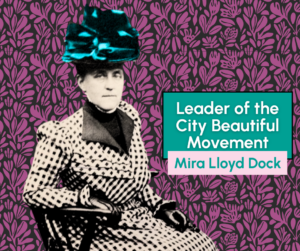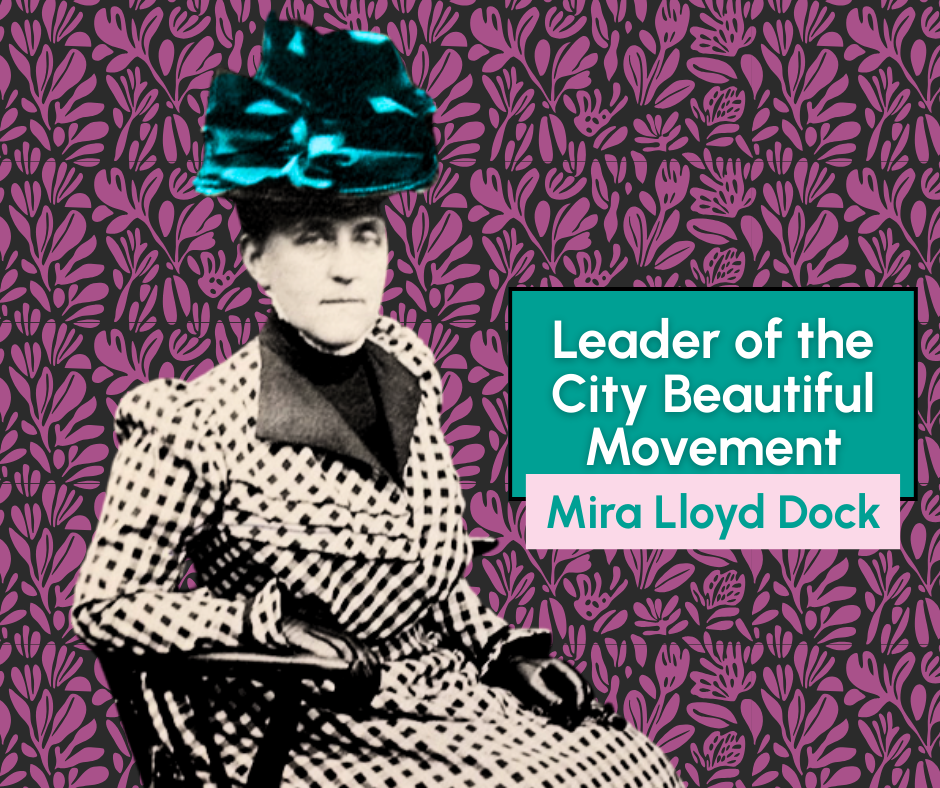
Mira Lloyd Dock, born in 1853 in Harrisburg, PA, is one of the people who gave the Progressive Era its name. Mira was from a wealthy family that ensured its daughters were educated, coming of age during Reconstruction and the Gilded Age. In this era, it was uncommon for women to be educated at the college level; however, Mira did not let that stop her, and she received a degree in botany from the University of Michigan.
Mira Lloyd Dock and Public Health Reform in Harrisburg, PA
In 1899, Mira attended the International Congress of Women in London, England, as a representative of the Pennsylvania Department of Agriculture. While in Europe, she saw the great efforts industrial cities were making to beautify and sanitize their urban spaces. Mira was motivated to bring this movement home. At the time, Harrisburg had no public health infrastructure. There was no public sewage, clean municipal water, or trash removal. The Susquehanna River functioned as the water source, sewage outlet, and waste dump. The streets were littered, muddy, and unpaved. These conditions spread disease constantly.
Mira Lloyd Dock and the City Beautiful Campaign
Mira started showing lantern slideshow presentations of the beautification efforts industrial cities in Europe were undertaking, compared to the squalor of the Commonwealth capital. She began the City Beautiful campaign to improve the city’s environmental health, build public parks, and integrate nature into urban spaces. She understood that communal pride in shared spaces and public health practices would not only help the citizens of Harrisburg in their mental and physical health, but also encourage economic development.
Her success in creating and advocating for natural spaces landed her an appointment to the Pennsylvania Forest Reservation Commission in 1901, the first woman in state history to be appointed to a government position. Over the next twelve years, she traveled the state inspecting lands and recommending that the state purchase and preserve them. During this time, she helped found and was a lecturer on botany at the State Forestry Academy.
Mira Lloyd Dock’s Legacy in Environmental Health and Conservation
After stepping down from the Forestry Reservation Commission in 1913, she helped lobby for the preservation of Niagara Falls, advocated for women’s suffrage, and worked to pass the federal National Parks Bill in 1916.
Mira defied the social norms of her time. At the time she grew up and advocated, women were expected to stay out of the public sphere, which was reserved for men. She advocated for those considered out of her class and brought not just environmental health to the forefront, but also proved that environmental joy is key to a thriving society. Her leadership was beyond her time, and we thank her immensely for her vision, knowledge, and determination to bring the change she wanted to see.
Learn more about Mira Lloyd Dock in this video from WITF.